Blog Archives
Do You Embody Or Represent Your Brand?
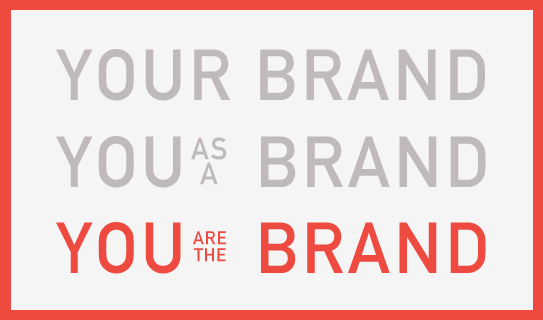
You can establish/own/run your brand; you can represent your brand; or you can literally be and fully embody your brand.
If you create a brand that is solely based on yourself (obvious examples include a fashion brand, thought leadership brand, Etc), know that if you ever have the desire or need to re-brand and/or re-position, you will face many challenges. Sounds logical after the fact, but as you go down that path of associating your name with the brand, it is easy to let the ego, or the simplicity of finding the domain name, run the branding process and push you into the limelight for good (may that actually be for better or worse!).
The issue of personal brand re-positioning will gain public attention during the US presidential election next year as we will be faced with two very different (and different types of) personal leadership legacy brands. Who is Hillary Clinton 2016 is what I pondered in The Washington Post (read this past Sunday’s cover story here) as we are collectively trying to re-define what her brand stands for today. Is the latest Bush brand in fact what the general public would assume it being based solely on his brand inheritance? I am not in politics (and smart enough not to discuss politics as part of my professional blog), but this comparison is the easiest way for you to watch the strategy, drama, and difficulty of personal brand re-positioning unfold on the big stage.
If you decide to be your brand, like a Martha Stewart did so famously before you, the coming months might make you re-consider and opt to solely represent your brand instead.
“You Told Me My Company Name Sucks”
…was the subject line of an E-Mail I received a few days ago. Needless to say, I was intrigued to read on:
“I called my company “(Name Withheld)”, but you told me it was horrible. For that reason I wanted to reach out and say THANK YOU!”
He listened and he turned the page and now he is grateful for my frank advice just as much as for him listening and acting upon it. This is how I want to start off the New Brand Post for 2015 as it sums up what is key to branding a new venture, and what I want you to keep upfront and center this year.
When you start a new venture, or initiate a new product offering, you tend to know best. You know your product best, you know your audience best, you know your marketplace best. You know your road map best. So, naturally, you are closing off quickly. Why? Because you know best.
Truth is, you just can’t be great at everything. I am not. No one is.
The moment you let go of that notion is the moment you open up to greatness. As a person, as a founder and as a brand.
Successful brands are built in collaboration with – and powered by insights from – specialists within their domain. The ones that are great at a certain thing, just like you are at your thing. It takes money and/or time, but for the ones who ‘get it,‘ like the one who wrote me above E-Mail, it will make for a better, if not great, brand.
This year be open, listen, absorb and analyze every step along the way as it relates to tasks like naming, brand identity, online presence, brand positioning, the same way you analyze, and more often than not over-analyze, each feature of your product or service offering. Branding is the first feature your target audience will be exposed to. It better click the right way, right away.
The Secret Behind Big Brands And How Entrepreneurs Can Learn From It
This was one of many topics I was asked about by a croatian startup site prior to the speech I gave two nights ago at the University of Zagreb for the Founder Institute. The interview was published in croatian, which you can peruse here if you speak the language (and want to analyze and help me understand why the Backstreet Boys invaded my Brand Atmosphere), but for the rest of you, here it is:
Startups, especially the ones you will be talking to in Zagreb, are mainly in their early stages. Do they even need branding in that stage? If they do – what kind of branding do they need?
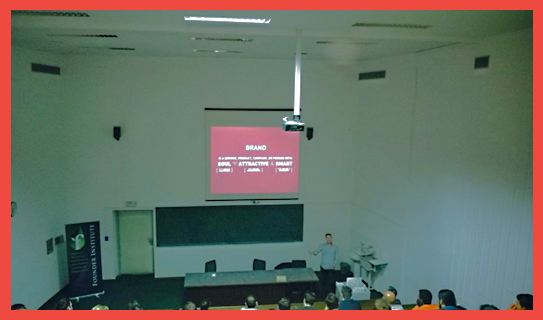
Fabian Geyrhalter speaking at the University of Zagreb for the Founder Institute, October 22, 2014
How can you brand yourself online when you are still a small startup, with a very small team and a limited budget?
When is the right time to hire someone (or a company) to help with branding?
Can you put together some sort of “emergency branding kit” for startups? What would that “kit” be made of?
It gets really difficult for a startup to choose their company name. It has to be unique, it has to be international, it needs to mean something. How do you achieve all of that and more with just one word?
How can a startup’s target audience help with forming a brand? What kind of feedback can that audience provide and how can a startup brand create an emotional connection with their potential customers?
What is the secret behind those huge, well known and beloved brands and what can small startups learn from them?
Branding For Startups: Learn what matters the most in 13 minutes
A short video for startups to learn how not to screw up branding.
CATEGORIES:
4 Crucial Steps You Need To Take Before Crafting Your New Venture’s Logo
Don’t hire us to create your logo. Not us, nor anyone else therefor. Sure, we could create a great logo for you. It would look timeless, be very well designed (I believe we are one of the best, and many agree), it would work across platforms and for years to come, and everybody would be telling you how much they love it. So why shouldn’t you hire us to create this important piece of branding for you?
Chances are you don’t need a logo designed. Not yet.
Chances are you need a brand built, and your logo is just a part of it. By creating a logo in a vacuum, and out of sync, you will likely fail. I don’t want you to fail. Nor be part of failure. I think we share this belief as entrepreneurs.
It’s the cart before the horse idiom: Why put the horse in place if we don’t know the message by the messenger yet?
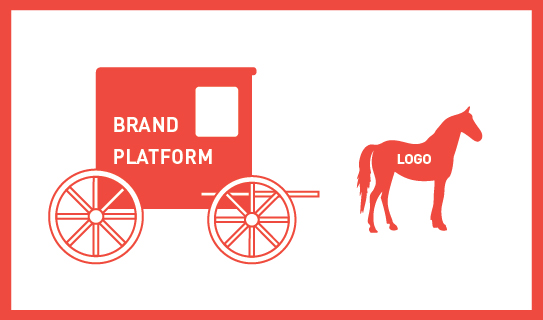
Below are 4 key elements you have to have in place prior to embarking on your logo design; they are the bare minimum requirements, the wheels of your cart so to speak:
1. You have a positioning statement in place that focuses on the ‘why’ and you stand tall behind it
2. You created 3 target audience personas that stand for who you are actually talking to/with
3. You know your brand personality and its associated keywords and are ready to act upon it
4. You have created a meaningful name that responds successfully to all of the above
If you don’t have these in place, creating a logo would be wasting your money, and (y)our time. It’s a lose-lose situation. How would any designer know what to design without these in place; how would the logo convey what it needed to convey; and finally, how could it connect with your audience? I don’t know, but I see it happen every day on the client’s expense.
Contact us if you need help getting there, as we love to assist and contribute, while speeding up that journey to your brand image.
Brand Naming: Guess Who ‘Blue It’? A Lot Of Them Did.
When I caught up with our long-term collaborator Matt Dandurand of Media Contour the other day he mentioned that he came across a breed of hilariously ‘mis-named’ IT companies. He had to share this phenomenon with me as it was very hilarious, yet so awfully sad at the same time, and he insisted that I dedicate a blog post to it that can turn this whole thing into something educational for my readers.
I was doubtful.
Then Matt shared how, during some research he was conducting on IT companies, he came across a company named ‘Blue IT’. He thought it was funny, especially when typing the url. A quick Google search later he found a slew of them that blew it, all the same way.
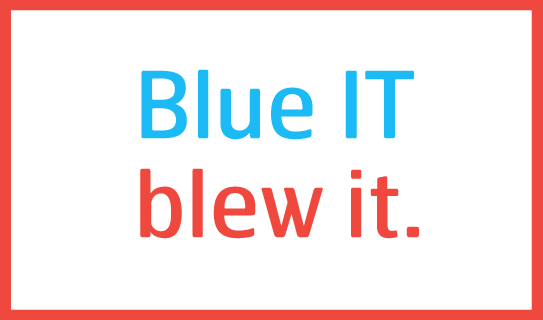
Now I am not in the business of picking on a random company’s name, it seems a bit cheap, but I do feel this serves as a great pointer to the fact that naming is to be taken seriously, regardless of company size and industry. Ample time needs to be spent to ensure, yes, that you don’t blow it. This guide will help you. It focuses on what makes a great brand name, now that we know what makes an unfortunate one.

The Post Host
Fabian Geyrhalter is the Principal of FINIEN, creating clarity for brand transformations.
JUST RELEASED
Key branding lessons to save time and money while winning hearts and minds.
CRITICALLY ACCLAIMED
How to turn any venture into an admired brand
THE #1 BESTSELLER
How to Launch a Brand